The Quiet Economy Nobody in Canberra Can Fully Claim
Australia keeps having the same public conversation. Prices go up, rent bites harder, community services strain, and everyone waits for a press conference to explain how relief is on the way. Meanwhile, a less glamorous economy is already running underneath the official one.
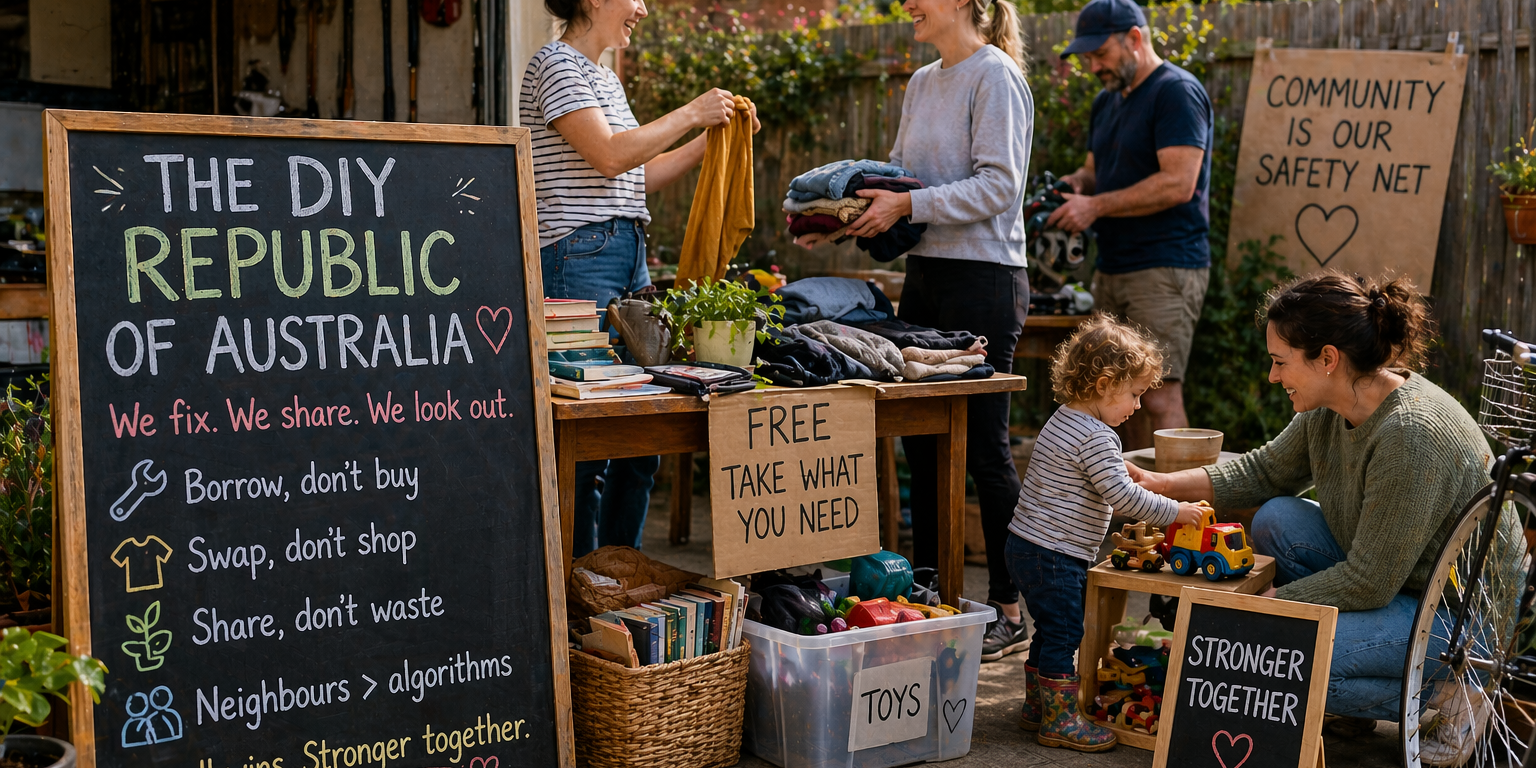
It is not a formal program. It is people swapping kids’ clothes in a local Facebook group, splitting bulk groceries with another household, borrowing a pressure washer instead of buying one, sharing school uniforms, using a community pantry, or getting three neighbours together before paying for a skip bin. None of that sounds grand enough for a podium. All of it is real.
That is the point of the DIY republic idea. Australians are not just absorbing broken systems. They are building small, scrappy workarounds around them, usually without waiting for permission and without pretending those workarounds are a full substitute for decent policy.
What the DIY Republic Actually Looks Like
The hard backdrop is not invented. ABS said consumer prices were up 3.7% in the year to February 2026, with Housing the biggest contributor at 7.2%. Foodbank’s 2025 Hunger Report said one in three Australian households faced food insecurity in the previous year, and ACOSS has argued that community organisations are under enough strain that only 3% say they can always meet demand. That is exactly the sort of pressure that pushes people into informal problem-solving instead of tidy, single-channel solutions.
What the evidence suggests
There is a stale way to read this period, which is that Australians are becoming more self-reliant because resilience is fashionable. The more honest reading is rougher. People become inventive when the formal route gets expensive, slow, humiliating, or unreliable.
That does not mean the social fabric has vanished. In fact, some of the official data points in the other direction. ABS said 2.93 million Australians were doing unpaid voluntary work in the 2021 Census, and its General Social Survey found that 49% of Australians aged 15 and over provided unpaid work or support to people outside their household in the four weeks before the 2020 survey. The country is not short on unpaid effort. It is short on systems that stop unpaid effort from becoming a permanent patch for avoidable hardship.
The DIY republic shows up in ordinary, slightly unromantic forms:
- neighbourhood buy-nothing groups and curbside exchanges
- repair cafés, men’s sheds, school P&C uniform swaps, and community sheds
- borrowed trailers, shared lawn gear, and pooled Costco runs
- grandparents doing extra care because formal childcare is expensive or unavailable
- food relief, community pantries, and local kitchens filling gaps that wages or payments no longer cover cleanly
None of that is weird in Australia. What is weird is how often it gets treated as invisible.
A simple local scenario
Picture two households in outer Adelaide. One has a toddler and a second baby on the way. The other has kids who have just aged out of cots, prams, and size-two clothes. In the same month, both are dealing with higher grocery bills and a school fee reminder. The “official” economy would tell the younger family to buy what it needs, compare prices, maybe chase a sale, maybe use credit if it gets tight.
The DIY republic version is less elegant and more effective. A cot, a high chair, a stack of clothes, and a bag of unopened nappies change hands for free. A third neighbour lends a trailer for a tip run. Another shares lemons, herbs, and half a box of pantry staples after a bulk trip. No one solved inflation. They did reduce the number of fresh cash transactions required to get through the month.
That is the piece people miss. Small exchanges matter because cash pressure usually arrives at the household level, not the policy level.
Why This Works, and Where It Clearly Does Not
The upside of these micro-systems is obvious. They save money, reduce waste, and make daily life less brittle. They also restore something that the cost-of-living debate often strips out, which is a sense that not every solution has to arrive through a retailer, a lender, or a ministerial announcement.
Where the simple take fails
- “Community will solve it.” Community can soften a blow, not replace income, housing supply, or functioning public services.
- “People should just budget better.” Plenty of households are already budgeting hard. Foodbank’s 2025 data is a reminder that hunger is showing up far beyond the stereotypical edge cases.
- “This proves government does not matter.” It proves the opposite. When informal systems are doing overtime, it usually means the formal ones are underperforming.
There is also a limit that needs saying plainly. Informal support works best when people still have something left to share, time, space, transport, skills, storage, or social trust. It works less well for isolated renters, newly arrived households, people working chaotic shifts, people with disability, and anyone already living too close to the edge. A tool library is helpful. It is not rent relief.
What not to do
Do not romanticise hardship just because people are coping creatively inside it.
Australia has a bad habit of turning necessity into a national personality trait. People make do, therefore making do becomes a virtue, then the virtue gets used as an excuse for why the baseline can stay shabby. That is how you end up praising resilience while quietly normalising shortages, delays, and impossible household maths.
The better stance is sharper. Keep the good habits, the sharing, repair, exchange, and neighbour-level cooperation, but do not confuse them with a complete answer.
What to Copy Without Turning Hardship Into a Lifestyle Brand
The useful part of this trend is not the suffering. It is the design logic. Households cope better when they reduce duplicated spending, lower one-off purchase costs, and make ordinary needs easier to meet without a full-price transaction every time.
Quick reality-check list
- [ ] Map the things you pay for rarely but expensively, tools, appliances, event gear, car trips, bulk buys.
- [ ] Separate status purchases from practical purchases for the next 30 days.
- [ ] Join one local swap or sharing channel before you need it, not after the bill hits.
- [ ] Build one repeatable exchange, uniform swaps, shared school runs, bulk produce splitting, or borrowed equipment.
- [ ] Keep one emergency giving habit as well as one emergency saving habit.
That last point matters more than it sounds. The DIY republic is not only about receiving help. It stays alive because households that are barely comfortable still pass along what they no longer need before it becomes landfill.
A calmer version of this idea is probably the one worth publishing into the Australian debate. Not “look how noble people are when systems fail.” More like: when formal systems wobble, households with any spare trust or organisation create side systems to stay functional. That is not quaint. It is economic behaviour.
The Part Worth Keeping Even When Things Improve
Some of these habits should survive a better economy.
Borrowing instead of buying every niche item is sensible in any inflation environment. Repair culture is useful whether prices are rising fast or not. Hand-me-down networks save money, lower waste, and make childhood less absurdly expensive. Community kitchens, school exchanges, neighbourhood houses, and volunteer-led spaces do more than stretch dollars. They reduce isolation, which is its own hidden cost.
The opposite-angle mistake would be pretending that all of this is enough. It is not. But the mainstream mistake is treating these networks as side stories when they are doing front-line work.
Australia does not only have an affordability problem. It also has a coordination problem. The DIY republic exists because people are coordinating anyway, quietly, locally, and often better than the official script expects.
FAQ
Q1. Is this article saying informal community support can replace government policy?
A1. No. The whole argument is narrower than that. Informal help can reduce day-to-day cash pressure and keep households functional, but it does not replace housing supply, income support, childcare, or well-funded local services.
Q2. What counts as a DIY republic fix in practice?
A2. Think shared tools, school uniform swaps, pooled grocery runs, community pantries, repair cafés, hand-me-down networks, neighbour care, and other local systems that reduce the need for fresh spending.
Q3. Why call it a republic at all?
A3. Because it behaves like a parallel civic system. It is made up of habits, trust, shared resources, and informal rules, not speeches, brands, or formal institutions.
Q4. What is the biggest mistake people make with this idea?
A4. Treating hardship as charming. The valuable part is the cooperation, not the pressure that made the cooperation necessary.
References
- Australian Bureau of Statistics, Consumer Price Index, Australia — 25 March 2026 — Supports the 3.7% annual CPI figure to February 2026 and Housing as the largest contributor at 7.2%.
- Foodbank, Hunger Report 2025 — 25 September 2025 — Supports the estimate that 1 in 3 Australian households, about 3.5 million, experienced food insecurity in the past 12 months.
- ACOSS, Budget Priorities Statement 2025-26 — January 2025 — Supports the finding that only 3% of community service organisations report they can always meet demand.
- Australian Bureau of Statistics, Unpaid work and care: Census, 2021 — 28 June 2022 — Supports the figure of 2,933,646 Australians doing unpaid voluntary work.
- Australian Bureau of Statistics, General Social Survey: Summary Results, Australia, 2020 — 29 June 2021 — Supports the figures on unpaid voluntary work and unpaid support to people outside the household.
Disclaimer
This post is general information and commentary only. It is not financial, legal, or social-services advice. Program access, eligibility, and local support options vary by state, council, and community organisation.
