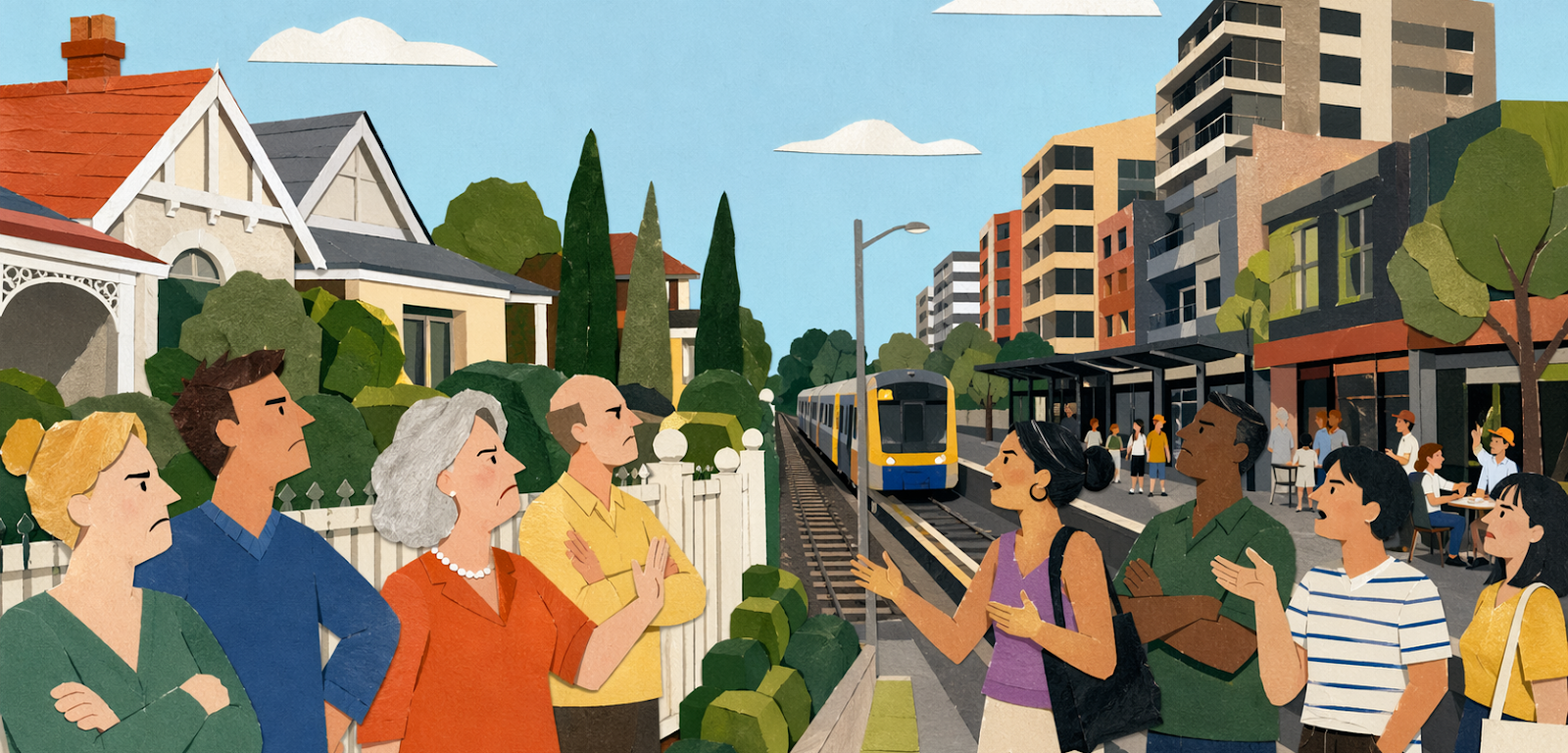
The dream stops at the property line
Australia loves the sentence “we need more housing” right up until the housing gets a street name. Then the tone changes. Suddenly everyone becomes an amateur expert in neighbourhood character, traffic shadows, tree lines, parking trauma, and the sacred right to keep the block exactly as they first enjoyed it.
That is the housing fantasy. People want cheaper homes, more supply, and shorter queues, but many of them only want those things to appear somewhere else. Preferably somewhere invisible. Preferably with no extra height, no extra noise, no extra neighbours, and no suggestion that a suburb near jobs and transport might need to hold more people than it did in 1998.
The problem is not that Australians like houses. Fair enough. The problem is pretending a national housing shortage can be solved while large parts of the country keep acting as if change is a local insult.
Everyone says build more, until the map gets specific
- Core claim: Australia’s housing politics says “build more” in the abstract and “not here” in practice.
- What people get wrong: They treat density as the problem, even though a shortage of homes in well-located areas is the bigger problem.
- Why it matters: When supply is blocked where people actually want and need to live, affordability gets worse, commutes get longer, and policy becomes theatre.
- Who this affects: Renters, first-home buyers, younger families, downsizers, key workers, and anyone priced out of well-connected suburbs.
- Bottom-line reality check: You cannot demand cheaper housing while vetoing extra homes near transport, jobs, and services.
Everyone says build more, until the map gets specific
The common script sounds mature at first. Australia needs more housing. Planning should improve. Builders should build faster. Governments should fix the mess. All true. Then the conversation gets local and the mask falls off.
The new apartment block is too tall. The townhouse project is too dense. The duplex changes the feel of the street. The station precinct needs more housing, but perhaps not on this side of the station. A suburb that is already close to jobs, schools, buses, trains, and shops somehow becomes the last place that should absorb growth.
The myths that keep this contradiction alive
- Density always ruins a suburb.
- Detached houses are the only real form of neighbourhood stability.
- More homes can appear without more people living closer together in desirable areas.
What the official housing story says instead
- The national target is not just more homes, it is more well-located homes.
- Governments are openly pushing planning reforms to support medium and high-density housing near transport, amenities, and employment.
- The housing shortfall is large enough that nostalgia for low-density purity is not a serious supply strategy.
This is why the debate gets silly. The same country that says housing is a crisis also keeps treating extra neighbours like a civic attack. We want nurses, teachers, tradies, and younger families to live near the places that need them, but many people still act as if those households should materialise without being housed nearby.
That fantasy has costs. It pushes more people farther out, where land may be easier to approve but daily life gets more expensive. Longer commutes, more car dependence, weaker access to services, and more pressure on outer growth areas are not side effects. They are the bill for pretending established, well-serviced suburbs should remain lightly touched museums.
Detached-house nostalgia is not a housing plan
Detached houses are not the enemy. Australia will keep building them, and plenty of people will keep wanting them. The issue is that detached-house nostalgia has become a polite way of avoiding the maths.
Official housing policy is now built around 1.2 million well-located homes over five years. NHSAC says 177,000 dwellings were completed in 2024, below underlying demand of around 223,000, and its 2025 report says only 938,000 dwellings are forecast across the Accord period. That is not a narrow miss. That is a reminder that the country does not have enough room for sentimental planning politics.
Why detached-only thinking keeps colliding with reality
- Well-located land is limited, especially in suburbs already close to jobs and transport.
- Planning systems still add delay, discretion, and cost.
- Housing construction productivity has been weak for decades, so the system is not in a position to waste easy opportunities.
There is another awkward point people do not love. Higher-density housing is not automatically the villain in the productivity story. NHSAC notes detached construction firms tend to be smaller than firms engaged in higher-density construction, and says detached housing is likely to see fewer productivity improvements than higher-density dwelling construction. That does not mean every apartment tower is wise. It means the romantic idea that detached housing is the simple, efficient answer is not backed by the broader direction of the evidence.
What people say they want, versus what that usually requires
- What people say they want: Lower rents and lower prices.
- What that usually requires: More homes in places people actually want to live.
- What they often resist: More neighbours, more height, more infill, and less local veto power.
This is where the phrase “neighbourhood character” starts doing suspicious amounts of work. Sometimes it means real heritage or real amenity. Fair enough. A lot of the time it means preserving scarcity for the people who already got in early. That is not urban wisdom. That is just a nicer outfit for self-interest.
What honest housing politics would sound like
Honest housing politics would stop pretending this is a mystery. Australia needs more homes, and many of them need to be in suburbs that are already well connected. Not just in fringe estates. Not just in theory. Not just on PowerPoint.
That means more duplexes, townhouses, mid-rise apartments, and transport-oriented development in places that can support them. It also means less patience for the idea that every established suburb should stay visually familiar while somebody else absorbs the growth.
What a less fake debate would include
- More clarity: If a location is close to jobs, services, and transport, it should be a candidate for more homes.
- Less local theatre: Genuine design concerns matter. Blanket resistance to extra neighbours does not deserve automatic respect.
- More honesty about trade-offs: Keeping a suburb low-rise and low-change often means keeping it low-access for younger and lower-income households too.
- Better approvals: Faster, clearer planning systems matter because delay turns housing into a more expensive product before anyone even moves in.
The most revealing part of the whole debate is that governments have already moved. Treasury’s planning blueprint openly promotes medium and high-density housing near transport and employment. NHSAC says planning and zoning reform is one of the most significant policy actions needed to improve supply and affordability. The political system already knows the answer. Parts of the public just do not like how the answer looks from the front yard.
Australia does not have a housing honesty problem only at the federal level or the state level. It has one at the street level too. We want more homes. We just keep hoping they arrive without more neighbours. That is not policy. That is magical thinking with a council objection form attached.
FAQ
Q1. Is this saying every suburb should accept high-rise towers?
A1. No. The point is not that every street should be redeveloped at the same intensity. The point is that well-located suburbs cannot keep demanding affordability while resisting nearly every form of extra housing.
Q2. Why focus on density instead of only building on the fringe?
A2. Because outer growth alone does not solve the full problem. People also need access to jobs, transport, services, and established infrastructure, which is why official policy now talks about well-located homes, not just more roofs somewhere.
Q3. Does density automatically make housing cheaper?
A3. Not automatically and not overnight. But blocking additional homes in high-demand areas makes shortage problems harder to solve, not easier.
References
- National Housing Supply and Affordability Council, “State of the Housing System 2025” (2025). Official report. Supports the housing shortfall figures, the forecast shortfall against the Accord target, and the recommendation to promote greater density in well-located areas.
- Treasury, “Delivering the National Housing Accord” (accessed 2026). Official policy page. Supports the 1.2 million well-located homes target and the federal housing-supply framework.
- Treasury, “Increasing housing supply” (accessed 2026). Official policy page. Supports the planning blueprint focus on medium and high-density housing close to transport, amenities, and employment.
- Australian Bureau of Statistics, “Building Approvals, Australia, February 2026” (released 1 April 2026). Official release. Supports the current approvals backdrop, including the rise to 19,022 total dwellings approved in February 2026.
- Productivity Commission, “Housing construction productivity: Can we fix it?” (2025). Official research page. Supports the point that housing construction productivity has been weak for decades and that faster approvals and lower regulatory burden matter.
